
Sororitas ex Mycelio
Sororitas ex Mycelio is a collective working with performance, sound, and living systems.
Their practice treats fungi and other nonhuman organisms as collaborators, generating immersive works that merge bio-data sonification, choreography, and transmedia storytelling to explore entangled ecologies and altered ways of perceiving.
Suomi
Field work & artistic research across Finland's Taiga & sub-arctic regions
Sororitas ex Mycelio is the collaborative practice of artists Laura Puska (FI) and Tosca Terán (CA/MX), rooted in entanglements of performance, material exploration, and living systems. We first met in 2010 and have collaborated on various projects over the years. In 2025, we began Sororitas ex Mycelium as an ecofeminist duo practice and a platform for bringing our artistic practices into deeper conversation.
As a Finnish-Canadian duo, we are connected by the boreal forest, a biome that stretches across both of our home regions. Our shared concern for the planet has led us to approach the boreal forest not only as a subject or resource, but as our collaborator. Through this collaboration, we explore relationships between human and more-than-human life and ask how artistic practice can create new ways of listening to and living with the natural world.
Our work treats more–than–human organisms as co-authors that shape sound, movement and immersive experience. Sororitas ex Mycelio explores how human and more–than–human worlds interlace, inviting audiences to imagine alternative ecological futures. We call this idea ecological personhood*: The belief that fungi and microbes have their own claims to space, continuity, and self-organization, which humans must respect. As the world becomes more extreme, we ask, what the future of ecology could be if we take these claims seriously.
*Legal personhood has moved from rivers to trees: from the Innu-led Magpie River (2021) to Terrasse-Vaudreuil, Quebec's 2026 declaration of tree rights to life, growth, and integrity, echoing similar cases in Ecuador, New Zealand, and India. Responding to the tree declaration, Ecojustice lawyer Karine Péloffy noted that corporations already hold legal personhood despite not being alive, so why not forests?
Read About It- click on the text above
The work operates across two interconnected audience modalities: a local, embodied installation-performance influencing environmental conditions in real time and a remote, networked VR performance-environment.
Local participants form the physical and bio-electrical foundation of the system, while remote participants act as a distributed atmospheric layer.
Together, these audiences co-create a shared, multispecies environment whose stability and evolution depend on collective attention and relational dynamics.
The project will be realized as a 360 participatory performance-installation, developed in collaboration with choreographers and 3D environment artists, designed to function as both a live performance work and an immersive environment with a live quadraphonic soundscape.
Our Proposal
alterLife: interBeing
Immersive fabulations of what the forest remembers
"The forest is queer. Everything in it is very much more alive, more aware of what is going on." J.R.R. Tolkien
We approach the boreal forest (taiga) as both a personal and planetary space, an intimate place of belonging and a biome vital to Earth’s climate and biodiversity. We do not see the forest as a backdrop but as a collaborator: a living network of trees, fungi, lichens, and mosses entangled in cycles of survival and transformation.
alterLife: What the Forest Remembers is a performative installation and live, networked VR environment composed of hand-blown glass terraria embedded with gold as a conductive element. Each sculptural form houses living plants native to Finland’s Boreal regions, cultivating contained ecosystems within fragile, transparent membranes. These terraria function simultaneously as habitat, instrument, and interface. The glass bodies resonate and amplify subtle vibrations, air movement, touch, breath, and the micro-activity of the enclosed plants, while embedded conductive elements act as sensors to register bio-electrical signals. When activated by human presence, the sculptures become points of contact through which plant, environment, and body are brought into relation.
Grounded in queer ecology, the project approaches the boreal forest as a network of entangled, interdependent relations that exceed fixed boundaries between species. This framework extends into the design of the installation itself, where participants are invited to connect through touch and shared circuitry, dissolving the separation between bodies and foregrounding collective, multispecies experience. Participants engage the forms by wearing or holding them, completing circuits through touch. Galvanic skin response, breath, and environmental fluctuations are captured alongside plant bio-activity, producing a shared field of bio-electrical signals across multiple bodies. As participants connect with one another, the system shifts from individual interaction to collective co-composition. This biological and human data is transmitted in real time into a live, server-based VR environment. Within this space, performers and remote participants inhabit an evolving virtual ecosystem whose visual, spatial, and sonic conditions are continuously modulated by these incoming signals. The virtual world does not operate independently; it is activated and shaped by the combined presence of plants and participants in the physical installation. The installation is conceived as a 360º immersive environment, with terraria suspended overhead yet accessible to the body. As engagement intensifies, the space transitions from dispersed interaction to a collectively activated field.
For our "alterLife" fabulation, we position ourselves as Keepers of Continuity revisiting a crucial moment in the Earth's history. Our placement begins in the Northern Hemisphere, visiting the Boreal, asking her to recall the time when the human symbionts were held by the Gregorian Calendar, cutting her down, mining her humus, destroying the networks that connected her across Earth.
Reconnecting with what is known as the Vernal Equinox, we intend to follow a circular path, a Lunar calendar, as a way of guiding our movement and decolonizing ourselves.
The Terraria
Hand-blown glass terraria embedded with gold as a conductive element.
Each sculptural form houses living plants native to the Suomi taiga and Canadian Boreal regions, cultivating small, contained ecosystems within fragile, transparent membranes.
These objects function simultaneously as habitat and instrument. The glass bodies resonate, amplify, and translate subtle vibrations, air movement, touch, and the micro-activity of the enclosed plants, into evolving soundscapes. When activated by human presence, the sculptures become interfaces through which the body encounters plant life sonically and vibrationally.
Audience participants engage the forms by wearing or holding them, completing a circuit between human and non-human systems. In this act, the body becomes a conduit, entangled within a living acoustic ecology.
At a time when human life is increasingly detached from non-human voices, this work responds to the accelerating loss of natural soundscapes and the ongoing extraction of forest ecologies. As environments are silenced through urbanization, climate change, ongoing war, and industrial expansion, our sensory relationship to the living world is diminished.
By cultivating native plant species within glass enclosures, the work stages a tension between preservation and isolation: a living system held in suspension. The terrarium becomes both refuge and warning, a contained ecology that echoes broader conditions of environmental fragmentation.
The terrarium forms operating as musical instruments:
the concept is based off multi-chamber drone whistles, sluice-flutes, Mexican bird whistles that either hold water or are submerged in water to be slowly lifted out creating bird-like calls or deep drones. The glass terrarian-instruments will be created through a interdisciplinary practice: stitched, quilted soft-sculptural forms are cast into ceramic which are then turned into plaster moulds for glass blowing. The soft-glass blown forms are then drilled and fitted with flame-worked borosilicate glass tubes and scientific glass fittings for CO2 release and oxygen exchange. The tubes also perform as rudimentary flutes. High karat gold (& fine silver) can be embedded into the glass during the heat forming stages to later perform as galvanic touch-points which connect like electrodes to custom biodata modules and solenoids.
Through sound, the installation reactivates listening as a mode of ecological relation. It proposes that plants are not a passive background, but active participants in shared environments, carriers of subtle signals, rhythms, and presences that persist beyond human perception.
Glass, in this context, is not neutral. It is a barrier, an amplifier, and a lens, separating while making perceptible.
The work asks: what forms of attention are required to hear what remains?


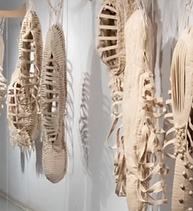
concept art
TouchDesigner + VR
Building networks with TouchDesigner enables the use of varied sensorial data and physical sensors/scanners.
We are currently conceptualizing the physical installation to present within a 360º space with the terrariums suspended from the ceiling yet wearable by myself and LPuska along with audience participants. Because we are first creating maquettes for proof of concept, we intend to build a few smaller versions of the Terraria that can be held in the hand.
Building a reactive and generative environment with TouchDesigner allows us to work with our 3D scanned forms captured during the residencies, incorporate sound elements, sensor data and projection map to walls, floor and even create a dome experience. Alongside TouchDesigner we are working with 3D modellers to create custom avatars for the Sisterhood. The choreographers use full body tracking.
Special Scheduled VR Performances
The installation-performance stands on its own, however the virtual component offers a deeper emotional journey. Working across multiple timezones we need to schedule the VR theatre work in consideration of our locations.
Working with the VR Dance Academy Tosca and Laura perform in both the physical space and the VR space. Their movements in VR become a gestural ritual in the physical space. Please visit here to read the foundational inspiration and story that fuels the VR environment/experience.
The climax of the performance is through the audience connecting and making the Boreal visible through sound.
Awarded residencies 2026- 2027 toward the alterLife project

Our residency starts September 2026
Vanha Kaivos Residency is located in Outokumpu, North Karelia
We will be working in the Kiisuhalli
A unique, huge, echoing space with cold conditions in winter. The space is impressive and has an echo that lasts for six seconds!
Our plan is to play back field recordings and voice readings to record them within Kiisuhalli, as well as the mine tunnels- if allowed.

Our residency starts February 2027 through March 2027
Ars Bioarctica fosters art-science research residencies, with a focus on responding to the subarctic environment and emergent ecological discourses. The locale’s unique ecology, social and economic cultures, as well as the scientific context and infrastructure of the Kilpisjärvi Biological Station act as a catalyst for site-sensitive research.
Tosca Terán contributes extensive experience in bioart, immersive media, and live VR performance, alongside long-term engagement with the Canadian Boreal region through biodata collection and ecological fieldwork. Her work forms the technical and conceptual foundation for the project’s real-time multispecies systems.
Her practice has evolved through a critical engagement with materiality and its ecological implications. Trained in metalsmithing, Terán initially worked with reclaimed and recycled materials, creating hand-built objects and sound-based installations. Over time, she became increasingly aware that even recycled materials remain entangled in extractive systems, prompting a shift in both methodology and material approach.
This transition led her toward bioart and the exploration of alternative, living materials. Working with mycelium, she began cultivating sculptural forms, films, and substrate-like surfaces that grow rather than are imposed, reframing her role from maker to collaborator. This shift also extended into a reconsideration of other materials, including the high energy demands of glass, and toward lower-impact processes such as clay and ceramic experimentation using local earths and techniques like Obvara firing.
Across these material shifts, Terán’s work has moved toward systems that are responsive, relational, and more-than-human, where form emerges through interaction rather than extraction. This trajectory directly informs her current practice, in which biological processes, human bodies, and technological systems are brought into dialogue as co-creative agents.
Within alterLife: What the Forest Remembers, this approach manifests through the development of real-time systems that translate bio-electrical signals from plants and human participants into immersive audiovisual environments. Drawing on her experience with biodata sonification, modular synthesis, and networked VR performance, Terán constructs frameworks in which living systems actively shape the conditions of the work.
Rather than representing ecological systems, her practice enables them to operate as dynamic participants, forming the basis for a multispecies feedback loop that links physical installation, human interaction, and virtual space.


L. Puska’s practice is rooted in sculpture, glass, and embodied performance, with a strong connection to Finnish Boreal environments and local artistic and research networks. Working as a performance artist with technical training in glass, she brings deep material knowledge and a sensitivity to form, balance, and structural presence.
Her work centers on the relationship between body, object, and environment, asking how we live with the forms we create and how these forms shape our behaviors, perceptions, and responsibilities. Through performative installation, she develops situations in which the body is placed in direct relation to material structures, emphasizing proximity, weight, fragility, and care.
Within alterLife: What the Forest Remembers, Puska grounds the project in the physical. Shaping how participants encounter and inhabit the work. Anchored in the body and its capacity for attention, connection, and responsibility.
Through her collaboration with Tosca Terán, Puska’s practice expands into dialogue with more-than-human systems, positioning the installation as a site where material, biological, and human relations are brought into shared experience.


Marinda Botha
Voice Over Artist, Actor, Physical Theatre. Marinda holds a Master’s degree in English Literature researching Storytelling in Virtual Reality. As an actor, she performed in award-winning Virtual Reality theatre projects, such as The MetaMovie Presents: Alien Rescue and Symbiosis/Dysbiosis.